Monday, January 30, 2012

Matt Otto Quartet at Jazz Winterlude

I came to an infatuation with jazz through Basie. And I’ll be the first to admit I was dragged to contemporary jazz by the nose hairs. Some of it remains too extreme for my tastes, and I’m convinced some is transitory. But some of the best jazz being produced today is, indeed, contemporary. And none is better than the music of the Matt Otto Quartet supplemented by voice and piano.

I spent most of a couple weekends back at Johnson County Community College’s Jazz Winterlude. Club-sized crowds enjoyed some of the best jazz in Kansas City today, a mix of traditional and modern music. But of every group I heard, Matt’s stood out as the most extraordinary.

Matt Otto and Gerald Dunn, either of whom could play sax for anyone (Matt on tenor, Gerald on alto), here are at once complementary and competitive, each clearly admiring the other’s solos. Backed by Jeff Harshbarger on bass and Michael Warren’s drums, the base quartet presents Matt’s complex compositions as both supremely engaging and completely accessible. Now add T.J. Martley’s smart and inventive piano. Then layer on Shay Estes’ remarkable vocals. She isn’t singing songs. This is the voice as an instrument, but unlike any instrument played by manipulating keys.

I’m groping for words to explain the wonder which filled the theater. Simply, I have not heard another group like this.

I wrote about and photographed the Matt Otto Quartet last year, here. But I’m so taken by their music, here they are again, from their Jazz Winterlude performance on January 21st. As always. clicking on a photo should open a larger version of it.

The Matt Otto Quartet. Left to right: Gerald Dunn, Matt Otto, Jeff Harshbarger, and Michael Warren

Matt Otto on tenor sax

Gerald Dunn on alto sax

The front line with Gerald Dunn on alto, Matt Otto on tenor and Shay Estes vocalizing

Michael Warren on drums

Jeff Harshbarger on bass

The Matt Otto Quartet plus two. Left to right: T.J. Martley, Gerald Dunn, Matt Otto, Shay Estes, Jeff Harshbarger, Michael Warren

Shay Estes, vocals

T.J. Martley on piano

Jeff solos as Shay admires

The saxes: Gerald and Matt

Shay Estes vocalizing. Behind her, Jeff Harshbarger.

Monday, January 23, 2012

No, It's Marketing

It’s not the J word.

Last week, our friend Plastic Sax identified the reason Nnenna Freelon’s Folly Theater show failed to draw more than some 400 people (here). “To a large extent, the barrier was antipathy to the j-word,” he wrote. “The jazz label may have drawn three-quarters of the existing audience, but it repelled even more potential ticket-buyers.”

Jazz the Repeller? Is a new super-villain threatening Gotham?

Is this a job for the Magic Jazz Fairy?

Well, maybe. Because it’s all about marketing.

Plastic Sax opines, “Music lovers of all stripes who appreciate Stevie Wonder, Amy Winehouse, Luther Vandross, Frank Sinatra or Mary J. Blige would have loved Freelon's performance.”

I don’t doubt a word of that.

Now, will somebody let those music lovers know?

With the rare exception of shows starring a name with established crossover appeal, the Folly jazz series seems to draw 400 patrons a show, give or take. That’s what happens when you market to the same audience through direct mail and newspaper ads. You’re reaching your core, and that’s important. But so is expanding your core.

The core is not limited by an act being labeled jazz. Plastic Sax himself proved it, last month, in his alternate guise as mild-mannered Business Manager of The Kansas City Jazz Orchestra (KCJO).

KCJO’s December concert sold over 1000 tickets. How? In part by selling about 400 seats through new media, through Groupon.

There’s good and bad to Groupon. A business forgoes substantial cash in the promotion. And businesses debate how many of those deal-chasing customers will return at regular price. Each Groupon is effectively a non-scientific data collection experiment.

But, more importantly, through Groupon, KCJO marketed beyond the core. They marketed beyond the 4000 people who receive every postcard. They reached beyond we old fogies who catch their ads in the newspaper. They reached out to a younger and broader demographic.

So did that younger and broader demographic realize they were buying a ticket to something called (horrors!) jazz?

They were buying a ticket to see The Kansas City Jazz Orchestra.

Yep, I’m fairly certain they knew this was jazz.

Will all return for another show? No. Will there be some level of stickiness? Yes, absolutely.

This was a jazz concert in Kansas City which sold over 1000 tickets. So don’t tell me a jazz concert in Kansas City can’t sell 1000 tickets.

For December, KCJO’s guest was to be Kevin Mahogany (who, unfortunately, couldn’t attend due to an injury). No doubt many came to hear Kevin. He grew up in this area. Kansas Citians know him. But is his appeal inherently broader than a properly-marketed Nnenna Freelon? Of course not.

It’s incumbent on both her management and the presenting theater to make her appeal known. If she really could attract “music lovers of all stripes who appreciate Stevie Wonder, Amy Winehouse, Luther Vandross, Frank Sinatra or Mary J. Blige,” why doesn’t somebody tell them? Why doesn’t somebody market her performance through new media, with links to song snippets and videos where a potential ticket buyer can hear the appeal for himself? Were there advertisements in media where lovers of Stevie Wonder and Luther Vandross would hear them? Were there efforts to expose an audience beyond the core to Nnenna Freelon’s music?

Was the marketing geared towards telling the core, hey, guys, we’re having another jazz concert, wanna come? Or did anyone try to market Nnenna Freelon, the Event? Because if it’s the former, don’t plan on needing to accommodate more than 400 people, give or take.

This year’s Rhythm and Ribs Festival drew, by my estimation, 7000 fans. Last year’s Prairie Village Jazz Festival was rained out, but organizers claim the 2010 event attracted a similarly-sized crowd. KCJO sold over 1000 tickets to their December concert. And everyone attending all of those events knew they were predominantly (or completely) jazz.

You could argue that festivals are events and are seen and sold differently than a monthly music series, so my comparison isn’t fair. I’ll argue that you pick concerts in your series that can be sold as events and promote them as events to fill the house. And I’ll argue that nearly every show must be marketed beyond the core audience.
Isn’t a street-definition of stupidity doing the same thing over and over and expecting different results? There’s nothing stupid about marketing to your core. Never ignore them. Never take them for granted. But if you market only to your core, why would you expect different results? If you market only to your core, why would you expect a larger audience?

Some jazz products will only appeal to that core. Know which those are and don’t spend marketing dollars unwisely. But others will reach more broadly. Recognize them.

The word jazz itself is no super-villain. But never attempting to reach beyond the base? There’s the threat.

Monday, January 16, 2012

Jazz Winterlude 2012

On this, I am unabashedly biased.

Because I first worked with Doreen Maronde when I was a volunteer organizing jazz festivals and she was with our partner, Kansas City Parks and Recreation. She left that post for Johnson County Community College (JCCC). She’s since retired from there, but not from organizing jazz festivals. For the third consecutive year, this retiree is organizing Jazz Winterlude. It happens this Friday through Sunday, January 20th through 22nd.

Friday’s music starts a 6 p.m. with the Bill Crain Quartet, followed by Crosscurrent, then headlined by Dave Brubeck’s sons with the Brubeck Brothers Quartet.

Saturday’s music starts at 12:30 p.m. with the Jazz Disciples. Also this day: the Brandon Draper World Jazz Quartet, Lynn Zimmer and the Jazz Band, the Matt Otto Quintet, the Will Matthews Quartet and the Kansas City Brass Quartet. Finally, Poncho Sanchez and his Latin Jazz Band headline Saturday night.

On Sunday, join a jazz brunch with pianist Roger Wilder leading a trio while you eat.

Friday actually starts early for 250 students participating in daylong clinics. Members of the Brubeck Quartet are hosting four of those sessions. And anyone can come and observe. One of the most intriguing sessions: At 4:30 p.m. Friday, Chris and Dan Brubeck host, Growing Up a Brubeck.

All this takes place inside JCCC’s wonderful Carlsen Center (with attached covered parking). Tickets are available at the Center’s box office, or by calling 913-469-4445, or online here. Any students with a current ID gets in for just $5 each day. More info on the festival is here. The weekend’s schedule is here.

Still don’t believe this will be a great weekend of jazz in Johnson County? Then take a look at the photos below from last year’s fest (clicking on one should open a larger version of it).

Millie Edwards Quartet. Left to right: Michael Pagan on piano, Bob Bowman on bass, Mille Edwards, vocals, Ray DeMarchi on drums

Diverse Trio. Left to right: Hermon Mehari on trumpet. Ben Leifer on bass, Ryan Lee on drums

Bram Wijands

Westport Art Ensemble with Gerald Spaits on bass, Dave Chael on saxophone and Todd Strait on drums (not pictured: pianist Roger Wilder)

Singer Megan Birdsall and saxophonist Steve Lambert with the New Jazz Order Big Band

Kim Park Quartet. Left to right: Joe Cartwirght on piano, Zack Beeson on bass, Kim Park on saxophone, Tommy Ruskin on drums

Hermon Mehari

Bram Wijands Trio. Left to right: Bram Wijnands on piano, Rod Fleeman on guitar, Tommy Rusklin on drums

New Jazz Order Big Band

Monday, January 9, 2012

So You Want to Own a Jazz Club

It can be done. I’ve done the research. I’ve written the business plan. I’ve prepared a five year budget showing annual profits while projecting less business than experienced consultants said it would draw, because I wouldn’t invest my own money unless the numbers worked with a cushion.

So I know it can be done.

1911 Main started as a jazz club and was gone in a proverbial flash. Jardine’s has been buried in high profile turmoil for most of the last month-and-a-half. That’s it. What more proof do you need that a jazz club cannot survive today in Kansas City? You want to own a jazz club? It would be easier to just throw your cash into a bonfire.

Bull. I know it can be done.

It takes a knowledgeable operator, the right location, solid marketing, sufficient operating capital, and a tight business plan.

I wrote a business plan to open a new jazz club in Kansas City over two years ago. I retained consultants who own and operate successful restaurants and clubs in Kansas City and other markets.

Research revealed two basic operating models for a successful jazz club: Turn the room twice a night with a high cover charge (used by clubs in New York and Seattle, and by Jardine’s on weekends) or open for lunch, not just at night, to generate sufficient revenue.

I found an ideal location within the downtown loop. Four other businesses on the street open for lunch, suggesting meaningful foot traffic. Research identified over 20,000 workers in walking-distance offices. And it was adjacent to two residential areas.

The space could be adapted to the character of a classic jazz club. The address was simple and memorable. Supported by professional operation and marketing, this location could draw music fans for dinner and drink at night and turn a profitable lunch operation during the day. The consultants saw enough potential that they offered to reduce their fees in return for an ownership stake.

Now consider 1911 Main.

I looked at that location. I saw a space that, with some tweaking, could become an ideal jazz club. But minimal weekday foot traffic in an area with less densely-packed offices limited its opportunities. True, other nearby restaurants have established solid daytime business (Grinder’s and the Cashew), but I was concerned it would take an establishment building an identity as a jazz destination too long to match their lunchtime success. More importantly, rent was nearly half again as much as the downtown locale.

I ran the numbers. 1911 Main would have been relatively inexpensive to move into, and that was attractive. But cold analysis said that once open, I could not project sufficient business to support a profitable jazz club there.

1911 Main Restaurant and Lounge, during its short jazz club life, eschewed cover charges and opened for lunch. Its choice of business model was clear. But I'd projected more than two years ago that at that location, that business model would not work.

Add to their woes poor marketing (ads in The Pitch, except during First Friday events, reached the wrong demographic) and start-up pains (twice when dining there I returned silverware covered with water stains) which discouraged business.

Success takes a knowledgeable operator, the right location, solid marketing, sufficient operating capital, and a tight business plan.

The Blue Room was recently recognized as one of the premiere jazz clubs in the country, and deservedly so. Jardines, if rumors are to be believed, will rise again. The Majestic showcases jazz in a space that was once a speakeasy. Take Five is pushing jazz to conquer the suburbs. The Phoenix has morphed into more of a blues bar, but still highlights nights of jazz.

Yet this area will support another jazz club. I’m certain of it.

The right location is one research says will support noontime business. The right operator is one experienced in the service industry, or one who employs operators with never-a-water-stain-on-the-silverware experience (the role my consultants would have fulfilled). The owner will have the capital to operate at least ninety days as he or she builds the business. And that business will be built through word of mouth, sustained with astute marketing, including strategically placed ads and a day-one online and social media presence.

The consultants told me, based on their operational experience, the business my jazz club would do in year one. I reduced their projections by $100,000 and still showed a profit. I then projected four to four-and-a-half percent annual growth and showed investors earning an eighteen percent return on their investment after five years.

Sadly, the recession bit a key investor and the club never happened. The space I targeted is no longer available. I’ve since resumed a career in advertising.

Any new business involves risk. But starting another jazz club in Kansas City, done right, need be no money bonfire. I have a business plan which says so. Other ideal locations exist.

I know it can be done.

Monday, January 2, 2012

In Lieu of 1000 Words: A Metheny Celebration

This waited two months because Pat was on tour, and his mother insisted it not interrupt work. That’s how she was, he explained.

Lois Metheny was mother to two of Kansas City’s – okay, Lee’s Summit’s – most celebrated musicians, Mike and Pat Metheny. Mike lives in the area (and, as I’ve repeatedly told him, needs to perform more often). Pat you may know from his 18 Grammy awards. Or, you may know Pat from his years growing up here.

Lois encouraged both in their music careers. She passed in October. But one of her last requests was a Celebration of Life jam session and party. As Mike put it, “It was her wish to go out on an upbeat note rather than with a sad funeral, so we are going to make sure it happens that way.”

Two days after Pat finished an 80 city tour, it did.

On December 11th, at the Arrowhead Yacht Club at Lake Winnebago, musicians, family and friends gathered. Mike and Pat led the jam session. Among the other musicians participating were Paul Smith, Bob Bowman, Tommy Ruskin, Gerald Spaits and Marilyn Maye.

Sometimes with jazz, you’re fortunate to be at the right place, right time, and hear something special. When Marilyn Maye and Pat Metheny – who may have won Grammys for more exotic music, but who grew up in Kansas City’s jazz community – performed a vocal and guitar duet, we heard magic.

As afternoon turned to dusk, we stepped outside. Lake Winnebago was a location where Lois asked her ashes be spread. Mike, Pat and Pat’s wife and children walked towards the end of the dock. Red tinged the clouds. The setting sun glazed the lake, beautifully.

Then Pat called out, “We’ve never done this before! We don’t know what we’re doing!”

They figured it out.

Mike suggested I bring my camera. The photos below are from the celebration’s jam session. As always, clicking on a photo should open a larger version of it.

Pat and Mike Metheny. Mike is playing the E.V.I., or Electronic Valve Instrumement.

The jam session. Left to right: Pat Metheny, Tommy Ruskin, Mike Metheny, Bob Bowman, Paul Smith.

Mike Metheny plays. Behind him is Tommy Ruskin.

Pat Metheny on guitar

Paul Smith on piano

Marilyn Maye and Mike Metheny

Pat and Mike Metheny

Gary Sivils tells the story of teenage Pat’s first professional gig, with Gary’s group at a local lounge. At the right, Pat reacts. I couldn’t possibly retell the story here as well as Gary told it. If you run into Gary, ask him about it.

Bob Bowman on bass as Paul Smith watches

Pat Metheny on guitar and Tommy Ruskin on drums

Pat Metheny and Marilyn Maye duet

Mike Metheny

Pat solos while Mike watches

Lois Metheny’s boys


Monday, December 26, 2011

The Magic Jazz Fairy Sees Skin in the Game

Instinctively, it flapped its wings in excitement, like a dog shakes its leg when scratched just so.

How many years had it been? it thought. How many years years had it been Kansas City’s Magic Jazz Fairy? Because never in all those years had it seen anything quite like this.

Every city has a Magic Jazz Fairy. It’s a phenomenon we’ve discussed before (here, here and here). How else to explain some jazz club owners never promoting yet expecting customers to show up? It’s because they know every city’s Magic Jazz Fairy tracks when jazz performances will happen, then flies around at night and whispers into the ear of every jazz fan when and where to find jazz, so that when we wake up, we know, we just know.

After all, it cannot be the club owner’s fault if they don’t promote and nobody shows up. They’re savvy businessmen. There must be someone else at fault. If nobody comes, it must be the fault of the Magic Jazz Fairy.

But this time, this was something different. This jazz club usually promoted itself well, though an online calendar, and Facebook postings, and emails. Now, however, nobody was coming because it was a jazz club with no live jazz.

Jazz musicians were boycotting it.

This was something entirely different. The Magic Jazz Fairy’s wings instinctively flapped again.

It had flown by the club just the other day. There were no signs in the windows, no indications of upcoming shows. It looked at the club’s online calendar. The calendar was blank. This club wasn’t promoting because, from all appearances, it had nothing to promote.

The Magic Jazz Fairy had seen the TV news stories on the club. They’re all on YouTube (and, with a major jazz club having nothing to promote, the Magic Jazz Fairy had time on its wings to look at YouTube). It had seen the multitude of blog posts. It had seen the accusations of addiction and abuse. It had seen the stories of staff being fired or quitting or not showing up. Not that how it happened mattered. The bottom line was that, for a time, there was no staff.

The owner spoke when triumphantly reopening the club’s doors, with a newly recruited staff trained and ready to serve. The Magic Jazz Fairy applauded the owner’s promotional savvy in using the press like that. But when reopening turned, apparently, into one week and out, the owner talked betrayal then publicly clammed up.

Betrayal, the owner claimed, by jazz musicians who refused to work the reopened and restaffed jazz club.

The Magic Jazz Fairy had seen the message the owner sent to over seventy email addresses, asking the jazz musicians to return. “It’s a new start for me,” the owner wrote. “If I was rude to anyone, I apologize and I plan on doing this efficiently and with eyes wide open.”

One musician, who played there often, responded to the list, “I’m sorry to say I can no longer support [this club] as a musician or patron. I’ve seen unethical and unprofessional behavior and a downright lack of human decency for years.”

Other musicians echoed those sentiments. Whatever sparked the staff upheaval, sparked much more. And it united Kansas City jazz musicians in a way the Magic Jazz Fairy had not seen in all its years on the job.

The mystical, winged being smiled impishly. It had seen plenty broadcast and written, and deservedly so, on the ex-staff. It had seen plenty written on the club’s owner. Yet it had seen little but betrayal accusations written about the city's jazz musicians.

This was no betrayal, the Magic Jazz fairy knew. There's no abundance of opportunities in any city in 2011 to make money playing and singing jazz. Yet here is a group of extraordinarily talented artists disciplined in denying an invitation to perform, and during the holiday season. These musicians have skin in the game. That, the magic jazz fairy knew, drove credibility to their charges. The mystical being did not know what went on behind the curtain in that jazz club. But it knew many of these musicians, and their united sacrifice said it could believe in them.

The Magic Jazz Fairy didn’t know what would become of the boycotted club. The owner may well be a savvy business person, but not savvy enough to draw customers to a jazz club without live jazz musicians. Selling the club seemed the most hopeful solution. With time, it thought, this situation would work itself out.

Meanwhile, there was work to do. Other jazz clubs remained open and were now even more vital to the jazz scene. And other restaurants and clubs were picking up some of the cancelled shows. Every Kansas City jazz fan needed to know about these opportunities.

The Magic Jazz Fairy smiled broadly. Like a dog scratched in that oh-so-perfect spot, instinctively, it flapped its wings.

Monday, December 19, 2011

KC Jazz for Christmas, 2011

’Twas the week before Christmas when a friend turned to me
And said, “I need a jazz gift for under the tree.
It must be KC jazz, a wonderful find,
So that when it is opened, she’ll scream, “It’s divine!””

First take Jacob Fred, as in Jazz Odyssey,
Their Race Riot Suite is the epitome
Of their music to date, a story told true,
History as jazz, always crisp, sometimes blue.

Or take Mike Metheny (also listed last year),
With a new retrospective, a pleasure to hear.
Whether swinging Miss Jones or a more complex track,
To Old Wine/New Bossa you’ll always come back.

You say you want vocals? All the Things You Are brings
KC’s top rhythm section while Laura Chalk sings.
Add Embrey’s guitar and Laura’s son Matt,
For the best jazz musicians, none better than that.

If you’d rather hear duos, just piano and song,
With Millie and Mike you will not go wrong.
Michael Pagan backing Millie’s strong voice
Makes this live recording a wonderful choice.

The People’s Lib Big Band of Greater KC
Played one show with dance, a wonder to see.
But if you missed Nutcracker and the Mouse King,
The music’s on CD, a great offering.

Sir Threadius Mongus plays jazz with an edge.
On Threads, a great front line. On that I’ll not hedge.
With Andrew McGhie, Matt Otto, Stan Kessler,
The talent’s superb. You just can’t do better.

Karrin we claim. KC long was her home.
So her CD, ’Round Midnight is one of our own.
It’s won rave reviews. In some it scored ten.
No surprise here, ’cause we knew her back when.

“This is great! It’s superb!” my friend yelled with a screech,
“I want them all! I’ll take one of each!”
And my friend did exclaim, ’fore he drove out of sight,
“Merry Christmas to all and to all a jazzed night!”

*****

• Jacob Fred Jazz Oddyssey’s Race Riot Suite is available from Amazon, here, or can be downloaded from iTunes, here.
• Mike Metheney’s Old Wine/New Bossa is available from Mike’s website, here, or from Amazon, here.
• Laura Chalk’s All the Things You Are is available from CD Baby, here.
• Millie Edwards and Michael Pagan’s Millie and Mike Live is available from Amazon, here, or can be downloaded from iTunes, here.
• The People’s Liberation Big Band of Greater Kansas City’s The Nutcracker and the Mouse King is available from Tzigane Music, here, or can be downloaded from iTunes, here.
• Sir Threadius Mongus’s Threads is available from CD Baby, here, or can be downloaded from iTunes, here.
• Karrin Allyson’s ’Round Midnight is available from Amazon, here, or can be downloaded from iTunes, here.

Monday, December 12, 2011

Myra Taylor

This is what I meant.

Myra Taylor:  Born in Bonner Springs, Kansas, but raised, for all practical purposes, around 18th and Vine. She hobnobbed with Bennie Moten and Count Basie, with Lester Young and Charlie Parker. She recorded with Harlan Leonard’s Rockets, one of KC’s renowned big bands. She traveled the world and sang, by her own description, swing learned in Kansas City.

In the 1990s, Myra returned here, and with the Wild Women of KC was part of one of the most vivacious and funnest groups we Kansas City jazz fans have had the delight to enjoy. Myra sang swing learned when Kansas City jazz masters dominated the music. Then others learned from her.

This is what I meant when I wrote last week that in Kansas City, we have a jazz culture and tradition, which even today is passed from one extraordinary musician to the next.

Friday, one of our last links to Kansas City’s jazz origins, the wonderful Myra Taylor, passed at age 94. What she gave us cannot be replaced, but neither can it be forgotten. So today, let’s remember Myra with two sets of photos.

The first is from the fall of 2003, when the US Park Service unveiled the plaque on the front of the Mutual Musicians Foundation designating it a National Historic Landmark. Outside of the Foundation that day, Chuck Haddix from UMKC’s Marr Sound Archives gave Myra copies of publicity photos from her younger days which she was obviously thrilled to see.

The second set is from February 27th of last year, when I photographed the Wild Women of Kansas City playing The Blue Room, celebrating Myra’s 93rd birthday. Some photos from that night were featured in a previous post (here). But here’s a few additional shots taken of the night's star (clicking on a photo should open a larger version).

Myra Taylor and young Myra Taylor

Presenting the photos to a delighted Myra

Myra with another young Myra

When the US Park Service unveiled the plaque designating the Mutual Musicians Foundation a National Historic Landmark, Myra Taylor was in the front row.

February, 2010 at The Blue Room, with 93-year young – and young is the right word – Myra Taylor sings with the Wild Women of Kansas City

We all applauded Myra

We'll miss you, Myra Taylor

Monday, December 5, 2011

Clubs in Transition

Restaurant leases typically contain a clause allowing them to not pay rent for any days they’re closed due to repairs needed to the landlord’s property. That’s why, when a restaurant closes and the business owner is still liable for lease payments, it’s not uncommon for the restaurant to post a sign saying it is closed for repairs.

Jardine’s, arguably Kansas City’s premier jazz club for two decades, has a sign posted in its front window which reads, Closed for Repairs. Internet chatter says the staff was laid off last week.

Meanwhile, in New York City, a renowned jazz club has changed formats. The Iridium is where electric guitar pioneer Les Paul played each Monday night. But it’s also a jazz institution, where Harry “Sweets” Edison, Frank Wess, Clark Terry and Junior Mance recorded a live CD in 1997, and where an Art Blakey alumni group recorded in 1998.

A November 12th New York Times article, here, describes the Iridium’s transition “into a guitar Mecca:”

“The club’s new emphasis becomes obvious from the moment you walk in. A score of electric guitars are displayed on the walls, some in glass cases. all signed by famous musicians: Eric Clapton, Jeff Beck, Tom Petty, Steve Miller.”

The article explains, “These are difficult times for jazz clubs, as shrinking audiences and an aging clientele make it harder to stay in business. The steps the Iridium has taken mirror the moves that jazz labels like Verve and Blue Note have made over the last decade to remain profitable, putting more pop musicians on their rosters to subsidize jazz recordings.”

So I guess that’s it. Will the last aging clientele to leave a repair-bound jazz club turn out the lights?

But first, consider this:

On October 29th, Kansas City jazz trumpeter Hermon Mehari and a group of musicians filled the Record Bar with 20-somethings for a tribute to Michael Jackson. The show mixed jazz and pop to the thrill of a large, youthful crowd.

And pianist Mark Lowrey fuses jazz with hip-hop at the Record Bar on the 21st of this month. Hip Hop may not appeal to me, but it doesn’t need to. I’m part of the aging clientele. Mark will be exposing the music to an audience packed with the next generation of clientele.

Kansas City’s spectacular young jazz musicians are reaching out to a broader base through jazz plus something shows. They’re expanding the music and its reach. They’re growing jazz.

Not that my generation is ready for lights out. The Kansas City Jazz Orchestra sold over 200 deals on Groupon for this Friday’s show. Considering that most of those were for multiple tickets, it’s a terrific new-media response for a 1000-seat house (and far better than I predicted they’d do. Sometimes, I’m thrilled to be wrong).

Also, before reaching for the light switch, take look around town (and at recent blog posts). Kansas City is home to two new jazz venues, 1911 Main and Take Five Coffee + Bar. That’s not enough locations to showcase all of the talent bursting this city’s jazz seams. But it’s not lights out.

A couple months ago, I was in Toronto, Canada, a huge metropolitan area with an all-jazz radio station. On Friday night, I went looking for jazz. I found a downtown club, with an atmosphere similar to Jardine’s. Before the band started, background music included Basie, “Lockjaw” Davis and Big Joe Turner. I felt right at home.

The night’s live band was one that plays the club every weekend. They were enthusiastic, rattling through standards and jazz-infused R & B, not unlike what City Light Orchestra once played. But this was not the quality of jazz you’ll hear in Kansas City. It wasn't close. The pianist pounded the keys like a pugilist. The trumpeter soloed with more subtlety, but lacked the sophistication of a Stan Kessler or a Hermon Mehari.

The difference, I suspect, lies with Kansas City’s jazz tradition and culture, and the lessons handed down from one extraordinary musician to the next. I still remember, years ago, a young guitarist describing a technique Claude “Fiddler” Williams taught him, with “Fiddler” adding, “I taught that to Barney Kessel.”

I don’t know that one band heard one night was typical of Toronto. I don’t know Toronto’s jazz culture. But I question whether the city is home to jazz masters passing on their knowledge and support to the next budding jazz master, like Kansas City.

A jazz culture thrives here.

I don’t know Jardine’s situation. I sincerely hope the club reopens, and soon. And let’s not forget that in recent years both The Phoenix and The Majestic reopened, under new ownership, after closing. This city has a history of jazz club revivals.

But what if Jardine’s is done? We have weekends at the Mutual Musicians Foundation. The Blue Room and The Majestic remain. Two other new venues are already open. Young jazz musicians are enticing their generation.

This may be a time of transition.

Because restaurants and clubs post a Closed for Repairs sign more often on advice of attorney than because they’re closed for repairs.

Monday, November 28, 2011

They're Listening to Jazz in the Suburbs

You drive up, and on one side you pass Zenail and Spa, and His and Her Fitness. On the other side is Nevaeh Salon. Admit it, this strip center is as suburban Johnson County as it gets.

Inside, on a Friday night, the crowd fills every seat. Folding chairs have been set up, but they’re not enough. Some people stand, leaning against a counter or a wall. They range in age from grade school to the gray haired. This crowd is as suburban Johnson County as it gets.

Take Five Coffee + Bar last Saturday night
Except they’re listening to jazz. Stan Kessler and Joe Cartwright are on stage. The audience is not talking, there are not thirty conversations competing with the music. Instead, music fills the room, packed with people who are listening to jazz.

In a coffee house. In suburban Johnson County.

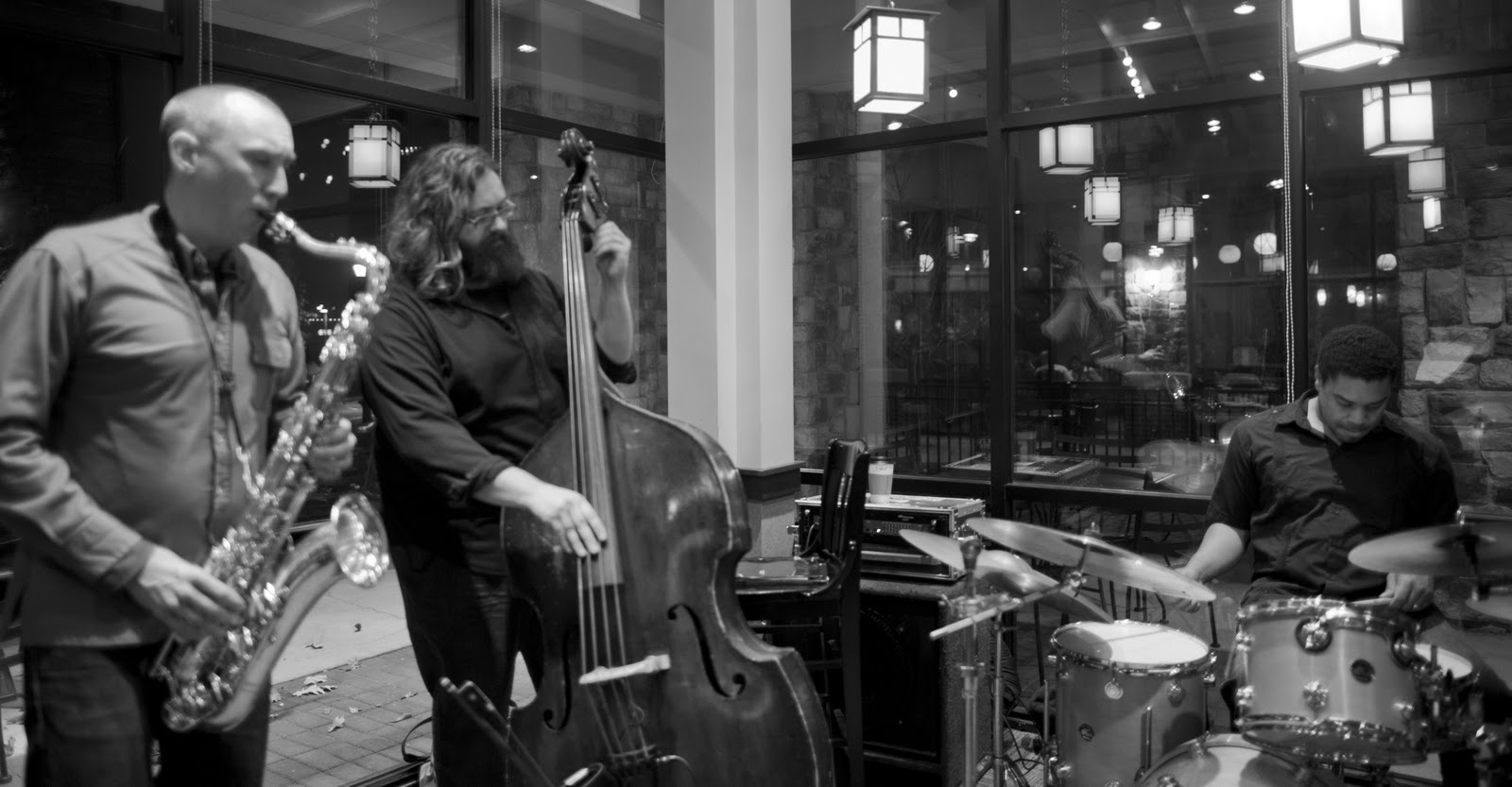
Matt Otto, Jeff Harshbarger and Michael Warren perform
This is one of the Kansas City area’s new jazz venues, Take Five Coffee + Bar, in the strip center at the northeast corner of 151st and Nall in Leawood, Kansas. That’s right, in Leawood. Which is as suburban Johnson County as it gets.

In the quarter century I’ve been listening to jazz in Kansas City, I’ve seen Johnson County jazz clubs come and go. I long ago concluded that jazz doesn’t work in Johnson County. People don’t move to the suburbs looking to slum a little urban grittiness at a juke joint down the street. That – at the risk of unfairly generalizing – is what most Johnson Countians think the city is for.

Matt Otto and Jeff Harshbarger
The thought of jazz in a quiet coffee shop, where customers come earlier in the day for muffins and cappuccino, but which also serves wine (and Coke to those grade schoolers) and stays open long past your Starbucks-on-every-corner, never occurred to me. I equated jazz with urban grittiness, and Kansas City’s jazz clubs delivered.

So credit Take Five owner Lori Chandler for pursuing a different vision and, based on the recent packed house, one which appears to be taking hold in Johnson County. Credit her for opening a clean, suburban room, with some plush easy chairs and a fireplace, tables on which to set your latte or wine, carpeting, and angled beams which contribute to an acoustically wonderful space.

Jeff Harshbarger and Michael Warren
On Saturday night the crowd was a bit smaller, and some high schoolers talked through the first set. But the space seemed to swallow that conversation. leaving the music clear. I sat in one of the easy chairs – which can also swallow you – listening to Matt Otto on tenor sax, Jeff Harshbarger on bass and Michael Warren on drums. These aren’t just some of the best musicians in Kansas City. These are among the best musicians playing jazz in 2011, anywhere. I’ve heard them before, in town, at Jardine’s and The Blue Room. Matt and Jeff will be part of The People’s Liberation Big Band at The Record Bar next Sunday, in Westport. This isn’t take-it-easy-on-the-suburban-neophytes jazz. This is jazz normally served with a slice of urban grittiness. But tonight, it’s in your uncle’s living room where you can savor every unamplified bass note.

(Jeff unpacked his amplifier for the second set. It wasn't needed.)

Matt, Jeff and Michael in Take Five
Well, it’s not exactly like a jazz band in your living room. Your living room doesn’t have floor-to-ceiling windows looking out on Eye Associates or Banana Island or a Walgreen’s drive-through. But it’s a more intimate setting than a typical jazz club, and it eventually pulls in everyone. By the second set, the high schoolers were no longer conversing. Most sat facing the band, listening, and applauding magnificent solos.

They’re listening to jazz in the suburbs.

Take Five Coffee + Bar